Formula 292 FAS3Tech: Welcome Addition
Formula 292 can handle the rough stuff.
December 9, 2002

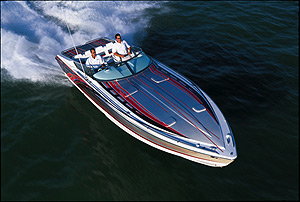
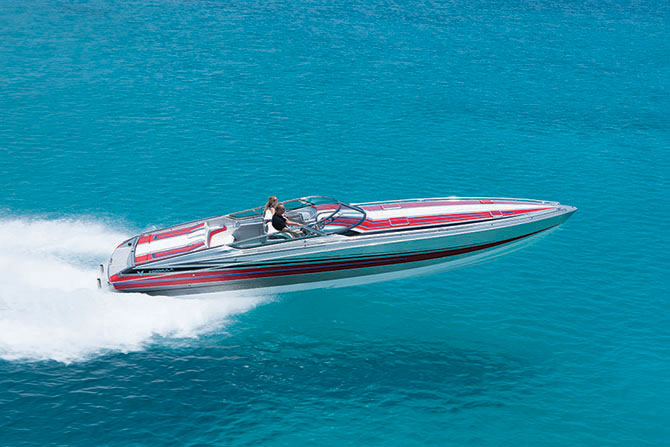
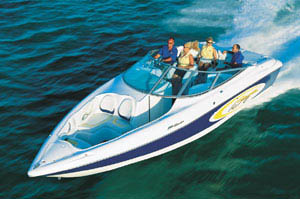
The handling manners of the 292 FAS3Tech were uniformly excellent. (Photo by Tom Newby)
Among the many things to like about Thunderbird Products, the Decatur, Ind.,-based parent company of Formula, is its commitment to model-line improvement. For all the talk of Formula's conservatism, the truth is that company CEO Scott Porter and his team aren't shy about making changes—if the changes make sense.
Phasing out the 271 FAS3Tech and essentially replacing it with the 292 FAS3Tech was one of those changes. The 271 is a fine boat, but its specifications created limitations. It couldn't, for example, accommodate twin small-block engines.
As we learned during the Placida, Fla., leg of our 2002 Performance Trials, that's not a problem for the 29'2"-long, 8'3"-wide 292—in fact, the boat only is offered with twin small-blocks. Our test model had a pair of Scorpion 377 motors from Mercury Racing and a few other options. As tested, the boat cost $152,105. Base price with two MerCruiser 5.0-liter MPI engines is $108,990.
Performance
The twin-step, 20-degree bottom of the 292 FAS3Tech featured strakes in a staggered pattern. But what first caught our inspectors' eyes were the boat's deck lines, which appeared lower than those of other FAS3Tech models. According to a Formula representative, the boat's deck was, in fact, designed to be more aerodynamic. (Don't be surprised to see a Factory 1 version running in the 2002 APBA Offshore season.)
Mated to the boat's twin 360-hp engines were Bravo One drives with 1.65:1 reductions and Mercury Bravo One 15 1/4" x 30" four-blade stainless-steel propellers.
In terms of speed and acceleration numbers, the 292 FAS3Tech was a mixed bag. We were pleased with its top end of 76.2 mph at 5,200 rpm on a 90-degree day with wilting humidity, but less excited about its 8.4-second (9.4 seconds with the tabs up) time to plane. In 20 seconds, the boat reached 57 mph. Midrange acceleration numbers for the 7,000-pounder were better and more consistent. The boat ran from 30 to 50 mph in 7.1 seconds and from 40 to 60 mph in 7.4 seconds.
The handling manners of the 292 FAS3Tech were uniformly excellent. In a series of drills that ranged from nasty slalom turns at ever-increasing speeds to mid- and high-speed circle turns with ever-decreasing radii, the boat stayed hooked up. The hull/twin-engine package also delivered great tracking at all speeds.
We didn't get the 292 FAS3Tech out in real big water—conditions didn't cooperate—but we did find some evenly spaced 2- to 3-footers on our test day. We found that a touch of negative trim worked best to keep the boat settled in cross-chop and quartering conditions.
Workmanship
Being a member of the FAS3Tech family, the 292 was built with Formula's structural grid (stringer) system, proprietary knitted triaxial fiberglass and AME 5000 and 1000 resins. Coring was used in the boat's hull sides and foredeck. Shiny gelcoat enhanced the vibrant Imron "Daytona Graphic" paint work, which was carried onto the two Bomar deck hatches, and the heavy-duty rubrail installed to protect it had all its screw heads aligned.
To make it easier to reach the anchor locker on the boat's nose, the manufacturer supplied deck rails. A stainless-steel cleat was installed on each side of the Taylor Made windshield. Two more of those cleats were aft on the gunwales. Elliptical handrails were provided on the port, starboard and aft sides of the sun pad, and the integrated swim platform had a folding ladder under a hinged lid.
When closed, the engine hatch/sun pad sat in a draining scuppered recess. An electric screw jack lifted the engine hatch, which was secured at the transom by hidden hinges.
Formula didn't fool around with the installation of the twin small-block powerplants. The engines were held fast on Mercury offshore mounts and L-angles through-bolted to the stringers, as well as the standard transom assemblies. The bilge finish was smooth and accessible, and access to minor services was good. In general, wiring was well-supported with cushion clamps and tie wraps.
Interior
Simple and elegant, the 292 FAS3Tech?s carpeted cabin had a long V-berth and a supple facing lounge. The galley consisted of a sink and faucet in a console with a Corian? countertop and an acrylic door, an ice chest and a couple of cupholders. Natural light came through the deck hatches and open sliding cabin door. In one of the lockers under the V-berth, there was a portable head unit.
Despite the cabin comforts, we're reasonably sure owners and their guests on the 292 FAS3Tech will spend most of their time in the cockpit—and running hard.
To keep people comfy at speed, Formula outfitted the boat's cockpit with McLeod power drop-out-bottom bolsters for the driver and co-pilot and a deep contoured rear bench.
White-faced Gaffrig gauges in red bezels were arranged above the tilt steering wheel at the helm station to starboard. Gaffrig throttles and shifters, with drive-trim control on the inner throttle handle, were well placed on the starboard gunwale, and rocker switches activated the boat's accessories, as well as its drives and tabs. The 292 lacked trim-tab indicators, a feature we feel provides must-have information.
Overall
A worthy successor to the 271, the 292 FAS3Tech is a welcome addition to a solid family. The boat does a lot of things well and lives up to Formula's considerable reputation for cut-above craftsmanship.
Hull and Propulsion Information
| Deadrise at transom | 24 degrees |
| Centerline | 29'2" |
| Beam | 8'3" |
| Hull weight | 7,000 pounds |
| Engines | (2) Mercury Racing Scorpion 377 |
| Cylinder type | V-8 |
| Cubic-inch displacement/horsepower | 377/350 |
| Lower-unit gear ratio | 1.65:1 |
| Propellers | Mercury Bravo One 15 1/4" x 30" |
Pricing
| Base retail | $108,990 |
| Price as tested | $152,105 |
Standard equipment
Two MerCruiser 5.0 MPI engines, head with dockside pump out, cockpit carpet, cockpit cover, tinted and tempered curved-glass windshield, stainless-steel hardware, concealed fiberglass anchor locker, integrated swim platform, two Bomar cabin venting hatches, McLeod electric-assist offshore-style bolsters, under aft lounge seating, tilt steering wheel, Gaffrig instrumentation, Gaffrig shifter/throttle with in-handle trim switch, digital depthsounder, rocker switches, courtesy lighting, fire extinguisher, sliding/locking door, Ultraleather lounge seating, Kenwood AM/FM CD stereo, automatic bilge pump and Silent Thunder exhaust.
Options on Test Boat
Upgrade to twin Mercury Racing Scorpion 377 engines ($36,720), Imron Gold graphic package ($3,975), Kenwood AM/FM 10-disc CD player with amplifier ($1,365) and VHF radio with antenna ($1,055).
Test Results
Acceleration
| 5 seconds | 18 mph |
| 10 seconds | 28 mph |
| 15 seconds | 43 mph |
| 20 seconds | 57 mph |
Midrange Acceleration
| 30-50 mph | 7.1 seconds |
| 40-60 mph | 7.4 seconds |
| 40-70 mph | 15.3 seconds |
Rpm vs. Mph
| 1000 | 9 mph |
| 1500 | 11 mph |
| 2000 | 13 mph |
| 2500 | 17 mph |
| 3000 | 36 mph |
| 3500 | 51 mph |
| 4000 | 61 mph |
| 4500 | 68 mph |
| 5000 | 75 mph |
Top Speed
| Radar | 76.2 mph at 5200 rpm |
| Speedometer | 80 mph at 5200 rpm |
Planing
| Time to plane | 8.4 seconds |
Fuel Economy
| At 35 mph | 1.5 mpg |
| At 45 mph | 1.6 mpg |
| At 55 mph | 1.6 mpg |
| At 65 mph | 1.5 mpg |
| At WOT | 1.3 mpg |
| Fuel capacity | 113 gallons |
Test conducted at Placida, Fla.
For More Information
Thunderbird Products
Dept. PB
2200 W. Monroe St.
Decatur, IN 46733
(219) 724-1404
www.formulaboats.com.